

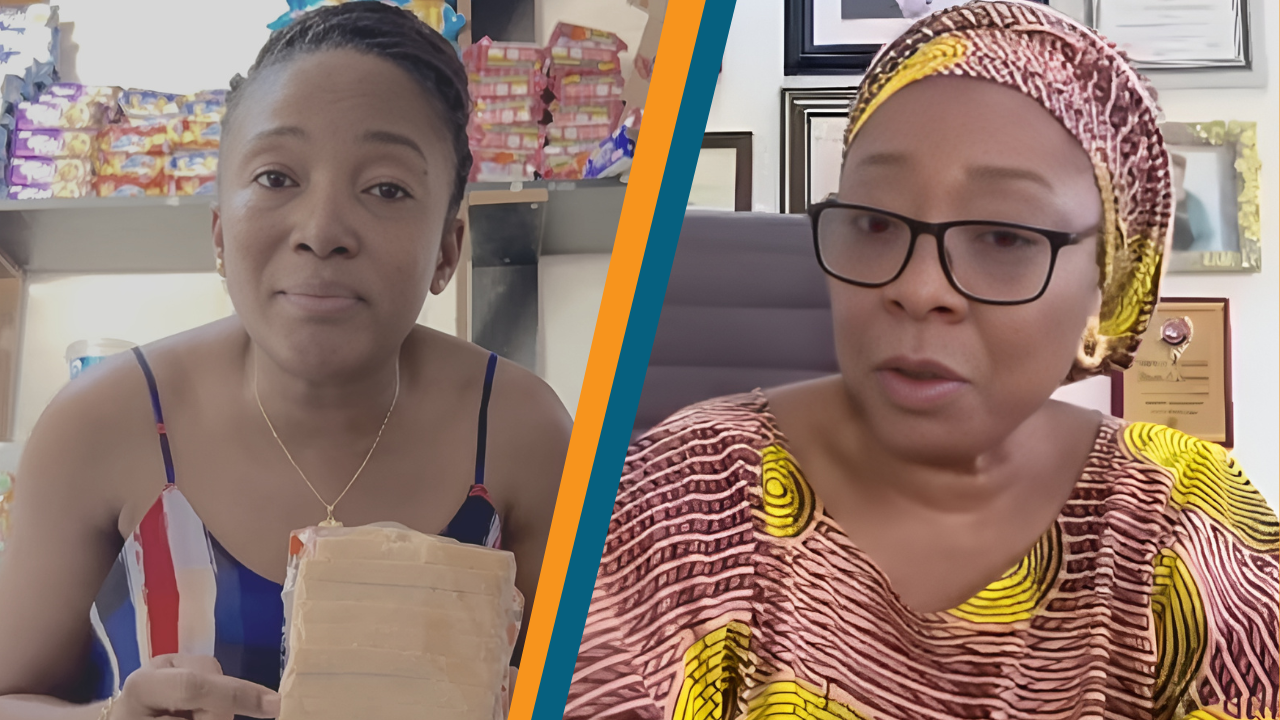
The bread was still fresh. That was what troubled Love Dooshima.
She had not bought it recently. The loaf had been sitting on a shelf in her provision store for two months, untouched, unsold, unremarkable except for the fact that it had not gone bad. No mould. No smell. It looked, she said, the way bread looks the day it is baked.
On 13 April 2026, she picked it up, held it to her phone camera, and told her TikTok followers what she was seeing. She did not name a brand. She did not show a logo. She told her followers to pay attention to what they eat. She put the bread down and ended the video.
Within days, Dooshima would be facing a N50 million lawsuit, a police summons, and a night in a cell at Zone 7 Police Headquarters in Abuja. The bread, as it turned out, was the least complicated part of the story.
How it started
Dooshima’s video spread quickly. The premise was simple enough to understand and unsettling enough to share: bread, a product most Nigerians eat daily, had apparently survived two months without spoiling. Viewers began speculating in the comments. One comment, among many, named a specific brand. Bon Bread, an Abuja-based bakery established in 2006, was identified by users who said the packaging visible in the video matched.
Dooshima did not post that comment. She liked it.
That distinction would become central to everything that followed.
Bon Bread’s chief executive officer, Maria Umeagwukadilo, said she saw the video and recognised the concern it was generating. She said she contacted Dooshima directly, seeking a meeting and asking where the bread had come from and how it had allegedly remained fresh for so long. Dooshima, by her own account, ended the call.
Umeagwukadilo would later argue that Dooshima’s decision to like the comment naming Bon Bread amounted to an endorsement of the identification. Legal analysts who reviewed the case supported a version of this position. According to Technext, Temitayo Sonuyi, head of dispute resolution at CrestHall, noted that brand recognition does not require a logo. The colour of packaging, he said, can be sufficient for identification, particularly for a product with years of market presence. The liked comment, he added, was a detail most public commentary had missed.
Whether or not it was legally sufficient, the company decided to act.
The lawsuit
A solicitor’s letter arrived shortly after. Bon Bread demanded that Dooshima take down the video, issue a public retraction, present herself at the solicitor’s office, and pay N50 million in damages. Dooshima went public with the letter.
In a follow-up video, she told her followers what had happened. She said she had been intentional in the original video; she had not named anyone, had not shown a logo, had not set out to harm any business. The morning after the video, she said, Bon Bread had appeared in her direct messages.
The public reaction shifted firmly in her direction.
Umeagwukadilo responded with her own video, posted on the company’s social media page. She said she had spent 20 years building Bon Bread from nothing into a business that employed dozens of people and supported many more. She said the bread had never, to her knowledge, lasted beyond seven days and that the company produced daily by order, not in advance. All ingredients, she said, were listed on every pack. The company met the standards required by the National Agency for Food and Drug Administration and Control and all other relevant regulatory bodies.
The comments on the post were disabled.
Separately, in an interview, she said:
“It pains me that after putting in 20 years of hard work, somebody on social media with a two-minute clip will cause so much damage.”
The police
On 20 April 2026, Love Dooshima went to Zone 7 Police Headquarters in Abuja. She had received a formal invitation from the Nigeria Police Force. The allegations listed in the invitation were cyberstalking, fraud, and mischief. Bon Bread had filed the complaint.
She arrived at noon. She was not released until 12:30 the following morning.
What began as a formal interview became a detention. As the hours passed, activists and lawyers began receiving calls. Concerns emerged about Dooshima’s health: she is hypertensive and, according to activist Precious Orueche, known publicly as Mama Pee, officers denied her access to her medication while in custody.
Human rights lawyer Inibehe Effiong arrived at Zone 7 in the early hours of 21 April alongside Mama Pee and others. He confirmed on social media that Dooshima had been brought out of the police cell following the intervention of Inspector-General of Police Tunji Disu. She was released at 12:30 a.m. Effiong signalled that further legal steps were under consideration.
The police had not issued a public statement on the matter at the time of publication.
After the cell
In a video recorded after her release, Dooshima described her time in custody. She said she had been treated as a criminal from the moment she arrived. She said the case against her appeared to have been decided before she walked through the door. She said officers had denied her medication.
“I went to the station believing everything was under control,” she said, “but it turned out control was under everything.”
She addressed the original video directly. “I did not keep that bread because I wanted to sabotage anyone,” she said. “I was only trying to educate people about what we consume and the dangers around us.”
She said she would not be silenced.
The wider questions
The Bon Bread episode has produced reactions on several fronts, none of them straightforward.
On food safety, experts have offered cautious commentary. A professor of food science quoted by Premium Times noted that common bread preservatives, including calcium propionate and sodium benzoate, are effective for up to two or three weeks under normal conditions. A shelf life of two months, she said, would be unusual and would warrant investigation. She was careful to add that there was, at the time of writing, no evidence that Bon Bread had used excessive preservatives or deviated from approved standards. She recommended that anyone with a concern take the product directly to NAFDAC for testing.
On the legal question, analysts have been divided. Some have argued that Dooshima had no case to answer; she named no one and showed no logo. Others have pointed to the packaging colours and the liked comment as elements that could complicate that position. The case, if it proceeds, will test where Nigerian law draws the line between brand identification and explicit attribution in social media content.
On the use of police in a civil dispute, the reaction has been less divided. Many Nigerians, including lawyers and civil society figures, have questioned whether a complaint of this nature, involving a private citizen’s commentary on a consumer product, was an appropriate basis for a police summons, let alone a detention that stretched past midnight. Effiong has indicated that this dimension of the case may be pursued separately.
What it revealed
bon Bread is not the first Nigerian company to respond to social media criticism with legal action, and it is unlikely to be the last. But the scale of public attention the case attracted suggests that the calculation behind such a response may be changing.
Brand analysts have noted the irony: the lawsuit that was meant to protect Bon Bread’s reputation introduced the brand to an audience that had never heard of it, and not under favourable circumstances. One commentator observed that the company inserted itself into a conversation it was not named in, and that this insertion, rather than the original video, was what made the story national news.
Umeagwukadilo, for her part, has said she expects the truth to emerge.
“We will get to the end of this matter,” she said. “We will see the truth from the lies.”
Dooshima, meanwhile, submitted the bread to NAFDAC for testing. The agency has not responded publicly to the controversy, and no results have been made available at the time of publication.