

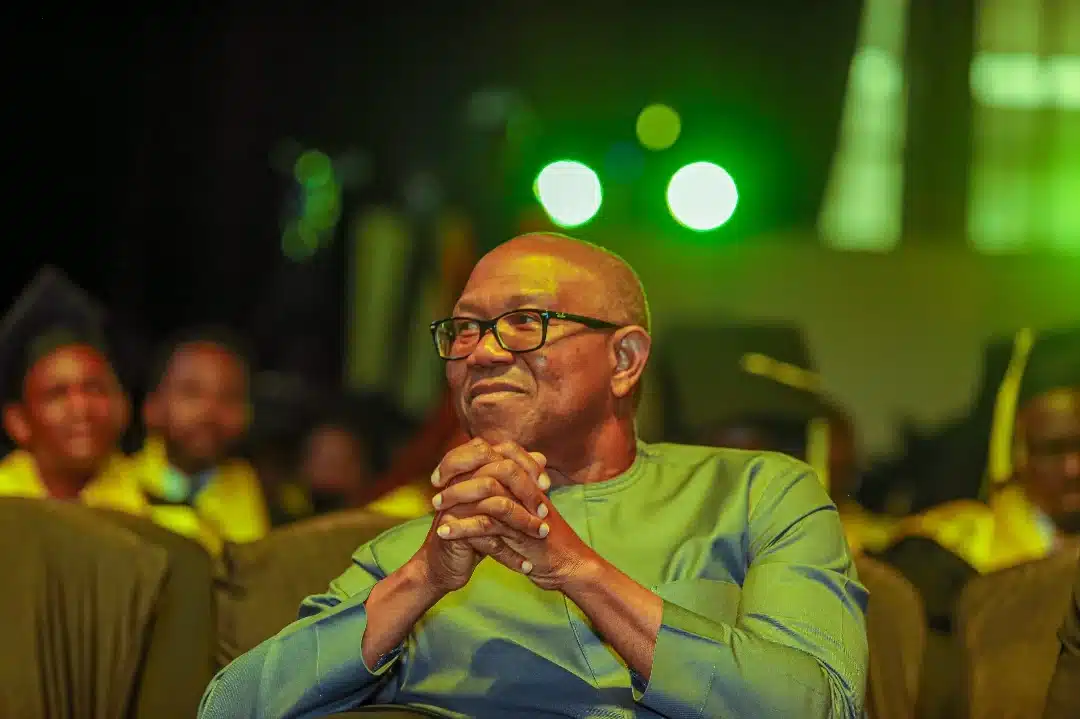
For months, questions swirled around Peter Obi’s next move. Would he stay with the Labour Party, or join another platform that could offer a real path to the presidency? His decision to join the African Democratic Congress answers that question, but it also opens a new one: how can the opposition transform moral authority and popular support into actual power in a deeply divided political environment?
While Obi‘s decision speaks to the state of Nigeria’s opposition politics and to a growing recognition that moral appeal alone is rarely enough to win power, his move forces hard conversations about unity, ambition, and the price of pragmatism in a fractured political space.
The 2023 presidential election remains the clearest evidence of how opposition fragmentation can shape outcomes. Taken at face value, the numbers still tell an uncomfortable story. Atiku Abubakar, running on the platform of the Peoples Democratic Party, secured about 6.98 million votes. Peter Obi, under the Labour Party, polled 6.1 million. Rabiu Musa Kwankwaso of the New Nigeria Peoples Party added roughly 1.5 million. Together, that is well over 14 million votes. Bola Tinubu of the All Progressives Congress won with about 8.8 million. Even allowing for regional variations, voter behaviour shifts and the unpredictability of coalition politics, it is difficult to escape the conclusion that a united opposition would have stood a far stronger chance of winning.
The problem, of course, is that unity is easier to argue for after the fact than to achieve in real time. The PDP entered the 2023 cycle already weakened by internal disputes and defections. The Labour Party, though energised by Obi’s candidacy, lacked the institutional depth to absorb the weight placed upon it. The result was a splintered opposition field where personal ambition, distrust and weak party structures proved stronger than shared purpose. Tinubu did not need to win a majority of votes nationwide. He only needed the opposition to remain divided, and it did.
It is against this background that Obi’s move to the ADC must be understood. The ADC has been described loosely as a coalition platform, though it is more accurately a gathering point for politicians who recognise that the existing opposition vehicles have run their course. Its appeal lies less in ideology and more in arithmetic. Politics, at its core, is about assembling enough forces to win. Obi’s defection signals an acceptance of that reality, even if it sits uneasily with parts of his support base.
The ADC’s prospects, however, are shaped by the same personalities that complicated opposition unity in 2023. Atiku Abubakar has made no secret of his continued presidential ambition. Kwankwaso, with his loyal following in Kano and parts of the Northwest, has also positioned himself as a central figure, signalling openness to alliance only on terms that reflect his political weight. Obi, for his part, carries the moral authority of a candidate many Nigerians see as honest and prudent, but moral authority does not automatically translate into control of party machinery.
These overlapping ambitions are both the ADC’s strength and its weakness. On one hand, it brings together figures with proven electoral value. On the other, it raises the question of who yields and who insists. Atiku has already drawn a line by insisting on a primary contest. That stance alone suggests that Obi cannot expect a coronation, no matter the enthusiasm of his supporters. Kwankwaso’s demands further complicate the picture. The ADC may be growing, but it is not immune to the same centrifugal forces that weakened the PDP.
This is where Obi’s dilemma becomes most pronounced. His political rise has been fuelled by a support base that sees him as different, cleaner, and morally superior to the traditional political class. For many of his most devoted followers, any alliance with established politicians feels like contamination. They argue that Obi’s appeal lies precisely in his distance from the old order, and that merging with it risks diluting his message.
Yet Nigerian political history offers a sobering counterpoint. Muhammadu Buhari spent three election cycles running largely on moral capital and personal integrity. He was widely regarded as honest and incorruptible, and his supporters believed repeatedly that victory had been stolen from him. What eventually changed his fortunes was not simply persistence, but strategy. In 2015, Buhari became part of a broader alliance that merged disparate interests under one platform. He did not abandon his reputation, but he accepted that reputation alone could not deliver power.
The parallel is uncomfortable but instructive. Obi, like Buhari then, commands loyalty and street credibility. He has a recognisable brand and a devoted base that cuts across regions and age groups. What remains uncertain is whether that base is broad enough to carry him across the line without allies who control structures, delegates and local networks. Elections are won not just on social media enthusiasm, but in party congresses, primaries and polling units.
Within the ADC, these realities will matter more than slogans. If the party insists on a competitive primary, experience and delegate management will count heavily in Atiku’s favour. Obi would have to organise beyond his core supporters and persuade party power brokers that he is not just popular, but electable within the system as it exists. That is a different challenge from mobilising mass rallies or online movements.
Looking ahead to 2027, several scenarios present themselves. A bruising primary could fracture the ADC before the general election, repeating familiar mistakes. A negotiated settlement could produce a joint ticket, most plausibly an Atiku Obi pairing, that seeks to balance experience with popular appeal. Such a ticket would raise its own questions, including how Obi’s supporters would react to a vice-presidential slot and whether patience for a longer game exists within his movement.
There is also the possibility that calculations change entirely. Nigerian politics has a way of shifting suddenly, driven by health, court rulings, alliances and unexpected crises. What seems fixed today may look very different in a year. What can be said with confidence is that Obi’s defection has altered the conversation. It has moved the debate from purity versus corruption to strategy versus isolation.
In the end, the health of Nigeria’s democracy depends not on personalities alone, but on the ability of opposition forces to offer credible, united alternatives. Obi’s move to the ADC suggests an understanding that winning power requires more than conviction. It requires compromise, negotiation and an acceptance of political reality. Whether that understanding translates into success in 2027 remains uncertain. In politics, as always, certainty is the rarest currency of all.