


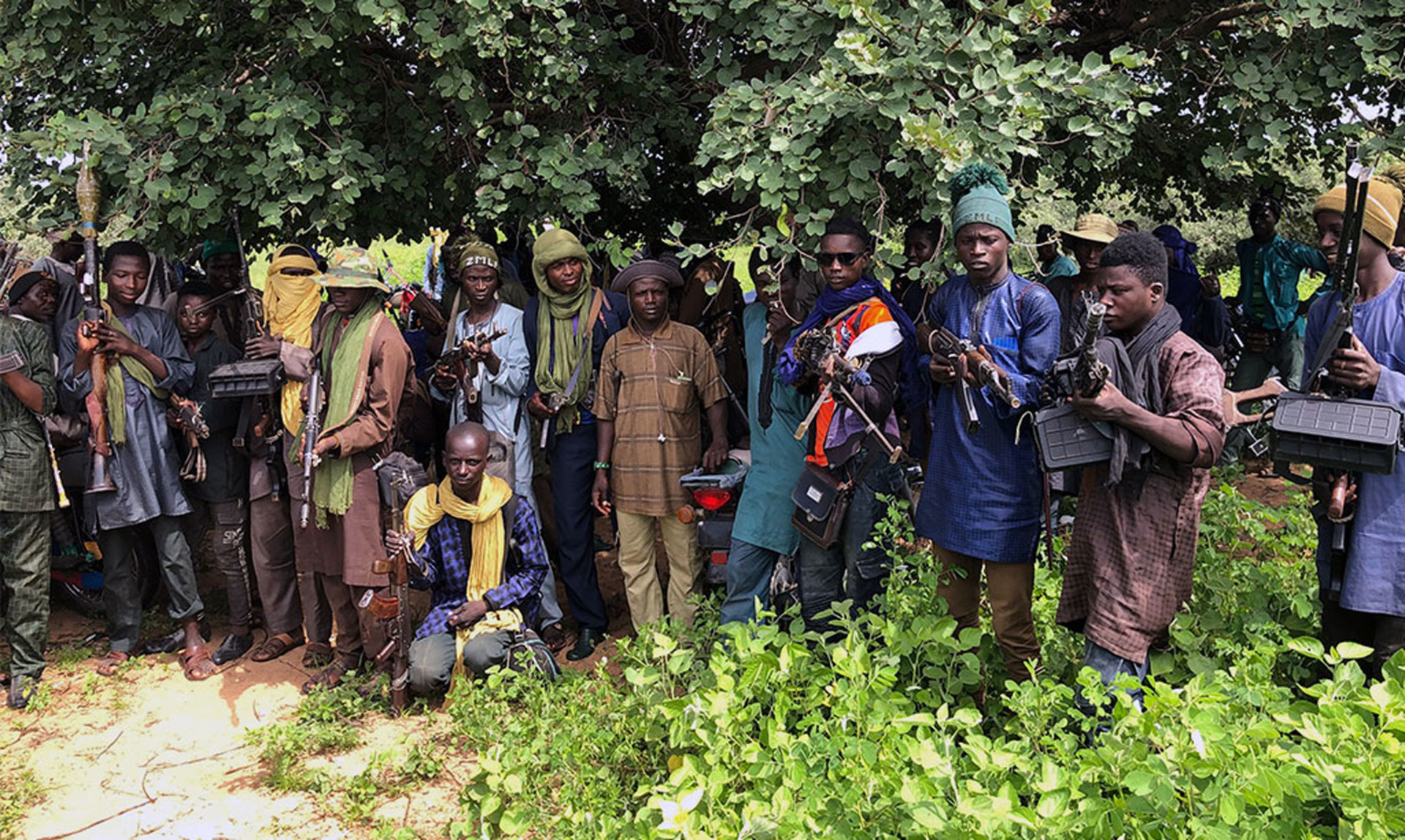
Nigeria remains engulfed in a wave of insecurity, with mass abductions, bandit attacks, and reckless violence now extending beyond school premises and conflict zones. Ordinary travellers, rural communities, and the very sense of safety for citizens across the country are all under threat.
Last week alone, harrowing stories emerged from multiple parts of the federation, including violent raids on schools, mass kidnappings of students and staff, and brutal assaults on innocent worshippers. These are not isolated events; they are symptomatic of a far deeper breakdown in protection and governance.
On 27 November 2025, while travelling from Akure to Abuja, our reporter witnessed a chilling attack in Oshokoshoko, a town near Obajana in Kogi State, where armed bandits intercepted a commercial bus along the Obajana–Oshokoshoko road. Multiple reports indicate that the assailants targeted two buses. One was seized while the second managed to escape with bullet shattering the driver’s finger. Passengers in the escaped bus reported that the bandits were wearing police uniform and opened fire on them while their driver tried to turn back to safety. Minutes later, troops of the 12 Brigade Nigerian Army, Lokoja, acting on credible intelligence, launched a special ambush operation, flanking the bandits on the corridor. The encounter reportedly resulted in the rescue of at least one kidnapped victim and the neutralisation of one armed bandit. The rescued individual was found in a distressed and weakened state and evacuated to a medical facility for treatment. This dramatic incident, witnessed firsthand, underscores a terrifying reality: even travellers on a highway are not immune from the menace of kidnapping.
Meanwhile, the wave of mass kidnappings continues unabated. On 21 November 2025, armed gunmen attacked St. Mary’s Catholic School in Papiri community, Niger State, abducting over 300 students and teachers. By 23 November, at least 50 students had escaped, but more than 250 remained in captivity. Just days earlier, 24 schoolgirls abducted from Government Girls Comprehensive Secondary School, Maga in Kebbi State, were reportedly freed. The incident, coming soon after a military unit had left the area, exposed glaring lapses in security deployment and protection of children.
These attacks revive the haunting memory of the 2014 abduction of 276 schoolgirls in Chibok, as well as subsequent kidnappings in Dapchi in 2018, Kankara in 2020, Kuriga in 2024, and many other villages and towns across the North. Today’s wave demonstrates that the threat is not waning; it is spreading. Moreover, it is no longer just schools at risk. There have been attacks on places of worship, on travellers, and on rural communities, reflecting a criminal business that seeks profits and instils fear.
The consequences go beyond the immediate victims. For education, repeated attacks on schools, especially in North-central and North-west states, erode parents’ trust. Boarding schools become death traps, and each abduction deepens the already alarming number of out-of-school children. For mobility, roads that once symbolised connectedness across states now carry the stigma of danger. Travellers, business people, commuters, and students face peril simply for moving. For national stability, when ordinary citizens believe they could be next, confidence in government and security agencies erodes, undermining social cohesion, economic activity, and community development.
The government, under President Bola Tinubu, has responded with troop deployments to hot spots and increased efforts by security agencies. But as the Obajana–Oshokoshoko incident shows, reactive operations and ambushes after credible intelligence are insufficient. The bandits are still able to strike. Alarmingly, the attack occurred between 1 and 2 p.m., just a stone’s throw from a military checkpoint, yet the bandits were still able to strike with relative ease. Similarly, in cases of school attacks, security deployment often appears superficial, even when there were prior intelligence warnings. The failure to prevent the raid on the Kebbi boarding school, and the ease with which gunmen infiltrated and escaped from the school in Niger State, expose deep structural failures.
A roots-and-branch restructuring is overdue. Nigeria needs community-based early warning systems around schools, major roads, and rural communities. Local vigilante groups, community leaders, and security agencies must collaborate to detect threats before they occur. Rapid-response capabilities must expand beyond the military alone. Civilian policing, road patrol units, and intelligence networks should complement army efforts. Schools should be protected proactively. Until insecurity is tamed, boarding schools in high-risk states should close or shift to day-school formats, with security presence that is constant and credible. Public disclosure and dismantling of terror-financing networks must be prioritised. Without cutting the money and logistics behind banditry, the government fights symptoms rather than causes. Finally, long-term investment in socio-economic resilience in vulnerable zones is essential. Poverty, lack of opportunity, and marginalisation often push young men into banditry. Investments in education, agriculture, and infrastructure are part of the solution.
The recent attack along the Obajana–Oshokoshoko road, witnessed by one of our own reporters, is an obvious reminder that the fight against insecurity is no longer distant. It is on our highways, in villages, in fields, and in classrooms. If Nigeria continues to react only after kidnappings and tragedies, it will remain forever behind. A bold reset is required, prioritising prevention, community engagement, transparency, and the protection of human life. The future of our children, our mobility, and our nation’s stability depends on it.