

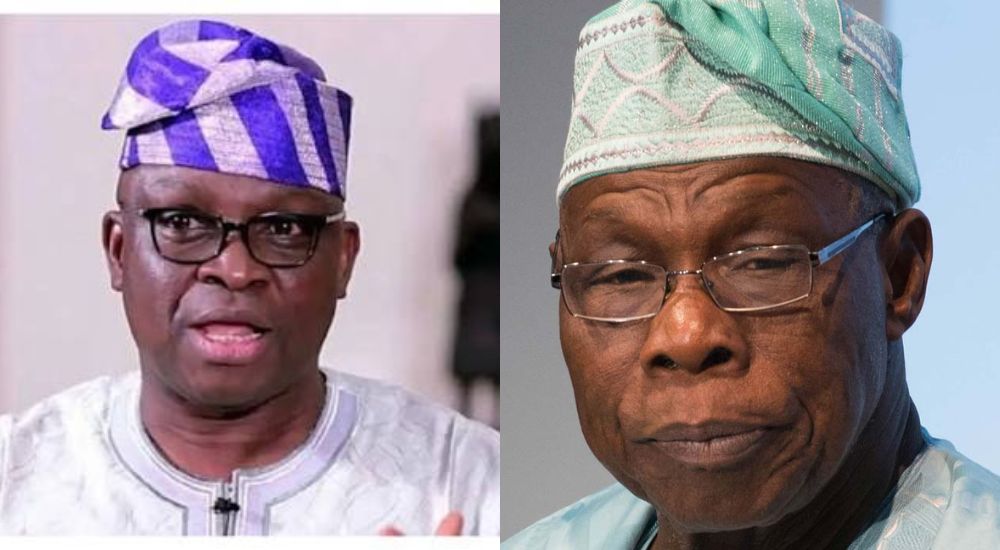
There are many things Nigerians have learned to accept with a straight face: fuel scarcity in an oil-producing nation, politicians promising to change every four years, and of course, the eternal soap opera starring Former President Olusegun Obasanjo and Former Governor Ayodele Fayose. So, when the two men decided to turn a 65th birthday celebration into yet another episode of their long-running feud, no one gasped. If anything, Nigerians sighed in collective recognition: ah, yes, the classics are back.
Their latest episode started on Saturday in Lagos during Ayodele Fayose’s 65th birthday celebration. In a hall filled with the country’s political royalty, from Vice President Kashim Shettima to governors, ministers, senators and enough security personnel to start a small battalion, former President Olusegun Obasanjo took the microphone and did what he does best. He reminded everyone that reconciliation with him is a state of mind, not a guarantee.
Fayose, who only recently travelled to make peace with Baba, clearly did not appreciate the public history lesson. In his graceful but not-so-graceful “thank you” letter after the event, he accused Obasanjo of launching “irresponsible comments,” adding that some unnamed person once suggested Baba be relocated to a zoo. For extra flavour, he threw in accusations of madness, dementia and skin that will never change its leopard pattern. Subtle, as always.
Obasanjo, not one to let a verbal grenade go unexploded, replied with a text message that could power the national grid if voltage were measured in shade. According to him, Fayose’s letter only proved the former governor is exactly who he has always been, “unchanged and unchangeable.” A classic Obasanjo response, complete with moral superiority and a pinch of “this boy cannot disgrace me.”
The drama goes deeper. Fayose invited Obasanjo to the birthday and even sent him money for a flight from Kigali. Baba, ever the statesman, acknowledged the gesture but revealed he never used the money because Aliko Dangote kindly sent a private jet. He added that the money was still with him, untouched. It was the kind of detail you casually share when you want the whole table to know whose friendship actually commands private aircraft.
But Obasanjo was not done. In front of the distinguished gathering, he revisited their political quarrels. He recalled how Fayose sent Osita Chidoka as an emissary because he could not reach him directly. He described Fayose and his wife as far from the ideal “omoluabi,” although he admitted the wife put up a good defense by apologising quickly. He even revisited the Ekiti poultry project, the one where he said he could smell a lie because he could not smell chickens. According to Baba, even Olagunsoye Oyinlola confirmed something funny was going on.
He also accused Fayose of lying about the presidential library donations and about a supposed ten million naira debt. As far as Obasanjo is concerned, governors contributed voluntarily, and he never owed Fayose a kobo. For those keeping record, this is at least the second time these two have clashed publicly. Their first major blowout happened at Oyinlola’s birthday, where Obasanjo reportedly called Fayose a “bastard,” and Fayose replied by describing Obasanjo as “the father of bastards.” Nigeria, truly, is blessed with poetic leaders.
Throughout Obasanjo’s fresh tirade at the birthday event, Fayose stood on the podium smiling politely. It was the kind of smile Nigerians give politicians when the cameras are on and generators have not been bought yet. But behind that smile was a man waiting to return fire.
Return fire he did. In his letter, Fayose mocked Obasanjo’s age, his sanity, and his legacy, then demanded a refund of his flight money since Baba ended up arriving via Dangote Air. Obasanjo’s final reply was brief, sharp and tidy. He informed Fayose that the money had already been returned through the same person who delivered it, “in the same bag” and unopened. A man of principle, or a man of pettiness? In Nigerian politics, both are often the same thing.
The exchange is entertaining, yes, but also a cautionary reminder of the political culture we continue to normalise. Former presidents and ex-governors trading insults like secondary school boys quarrelling over stolen meat is not exactly the model of democratic maturity. Their public feud may amuse Nigerians, but it also reflects the deeper fractures in our political class, the lingering grudges, fragile egos, and long memory of perceived slights.
In a country grappling with insecurity, inflation, and a citizenry losing faith in leadership, perhaps two elder statesmen publicly dragging each other is not the national pastime we need right now. Yet here we are, watching two men in their seventies and eighties replay old battles with new vocabulary.
If there is one thing to learn from their latest confrontation, it is that Nigeria’s political disputes never truly die. They simply retire for a few months, go on vacation, and return refreshed for the next episode.
And as long as birthday parties keep happening, this particular series is far from over.