

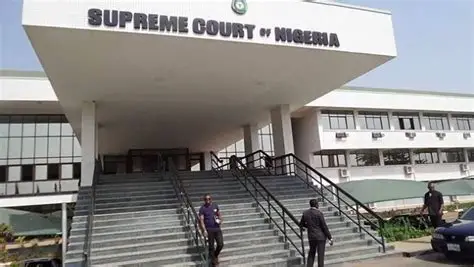
The Centre for Fiscal Transparency and Public Integrity says local governments are yet to enjoy the financial autonomy granted by the supreme court in July 2024.
The Supreme Court determined that funds from the federation account should be distributed directly to the 774 local government councils rather than via state governments.
The ruling was hailed as a watershed moment in grassroots governance reform.
In August 2024, the federal government established a 10-member inter-ministerial group to enforce the Supreme Court‘s decision granting LGAs financial autonomy.
However, in a study delivered in Abuja on Friday, the civil society organisation stated that despite the verdict, most councils have not received monies directly from the federation account, and that inadequate governance mechanisms continue to hinder accountability.
The centre’s executive director, Umar Yakubu, stated that there is little evidence that local governments have begun to gain from the verdict.
According to Yakubu, the research, titled Nigerian Local Government Integrity Index (NLGII): A Framework for Accountability, is the “first nationwide corruption and governance risk assessment of local councils”.
According to the findings, 85 percent of Nigeria’s LGAs are at “very high or critical risk due to poor governance, opacity, weak enforcement, and failing services”.
Yakubu said the index identifies priority areas where reforms and interventions are needed, covering eight governance pillars. He added that beyond autonomy, capacity building and training remain essential if LGAs are to deliver basic services.
“What the index has just done is to practically look at those areas where interventions are needed,” Yakubu said.
“There are things that need to be taken into consideration so that the local governments can effectively deliver what they are supposed to deliver to the people.”
He observed that transparency in Nigeria follows a tiered pattern, with federal institutions being the most open, states following, and local administrations lagging far behind.
The framework, he explained, tries to close the gap by establishing benchmarks that municipalities may use to improve governance.
Yakubu suggested that enforcement authorities such as the Economic and Financial Crimes Commission (EFCC), the Independent Corrupt Practices and Other Related Offences Commission (ICPC), and the Code of Conduct Bureau give special attention to councils in tiers 4 and 5, where the risks are greatest.
Chris Uwadoka, special adviser to Victor Muruako, chairman of the Fiscal Responsibility Commission, believes fiscal openness is critical for LGA growth because it minimises corruption by making financial activities apparent.
Uwadoka argued for open financial records to decrease temptation and prevent corruption among LGA officials.