

President Bola Ahmed Tinubu on has announced the end of the six-month state of emergency in Rivers State.
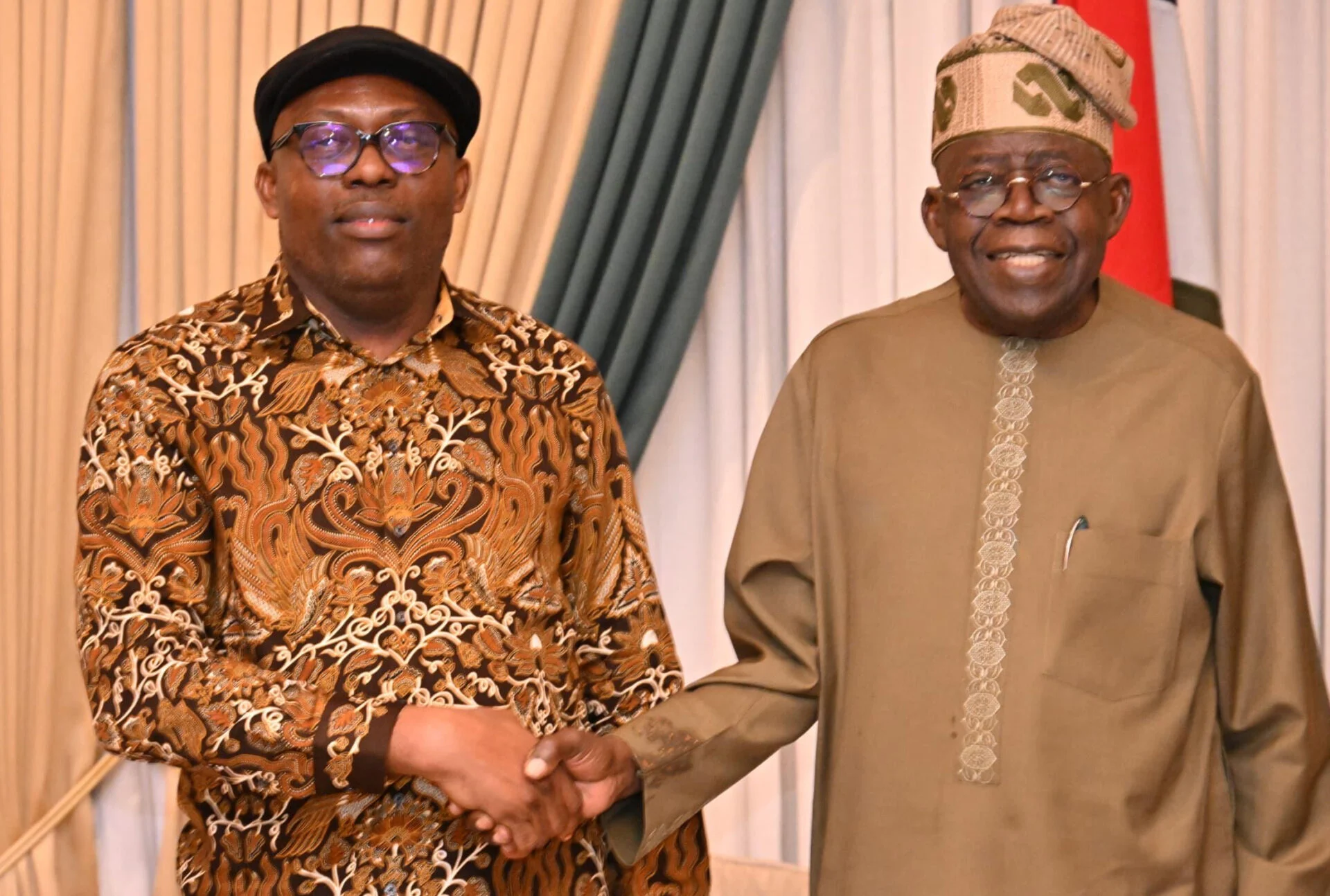
Tinubu made the statement on Wednesday, reinstating Governor Siminalayi Fubara, his deputy Ngozi Nma Odu, and the State House of Assembly led by Speaker Martins Amaewhule.
The President had imposed emergency rule on March 18, 2025, after a bitter political standoff between the governor and the majority of lawmakers brought governance in the oil-rich state to what the Supreme Court described as “a total paralysis.”
Under the proclamation, the offices of the governor, deputy governor, and 31 lawmakers were suspended while the federal government administered the state directly.
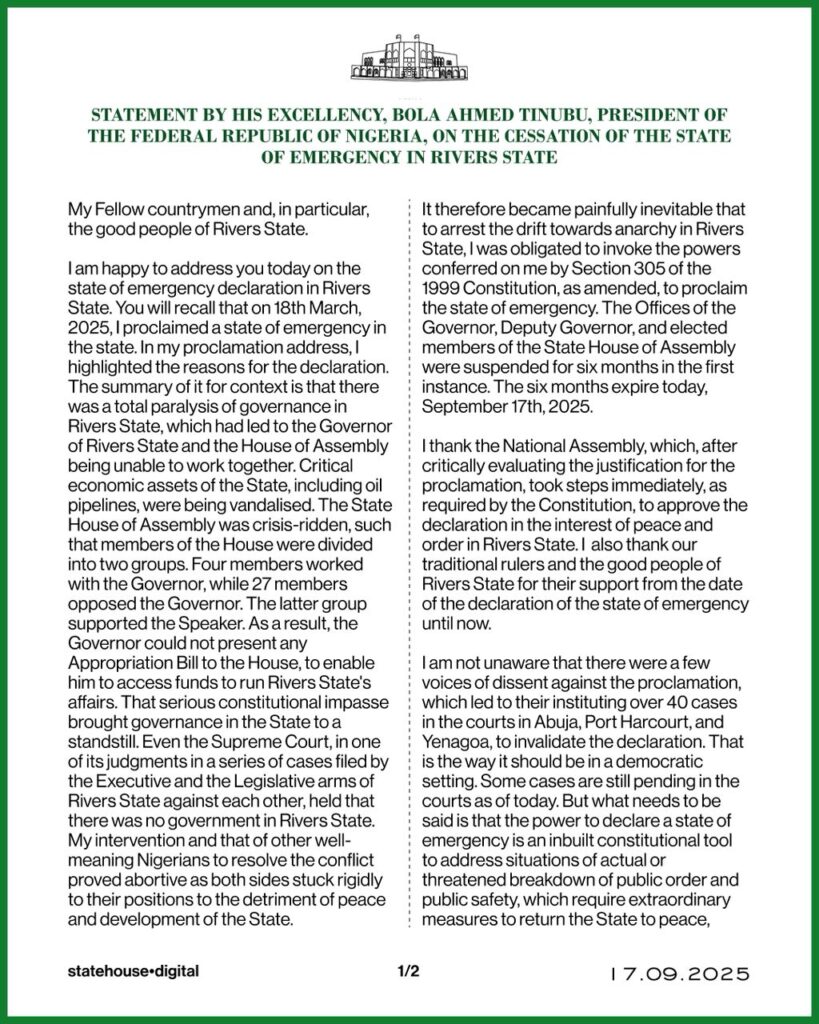
Tinubu said the intervention was “painfully inevitable” to prevent anarchy, protect critical assets, and restore order after repeated attempts to mediate between warring factions collapsed.
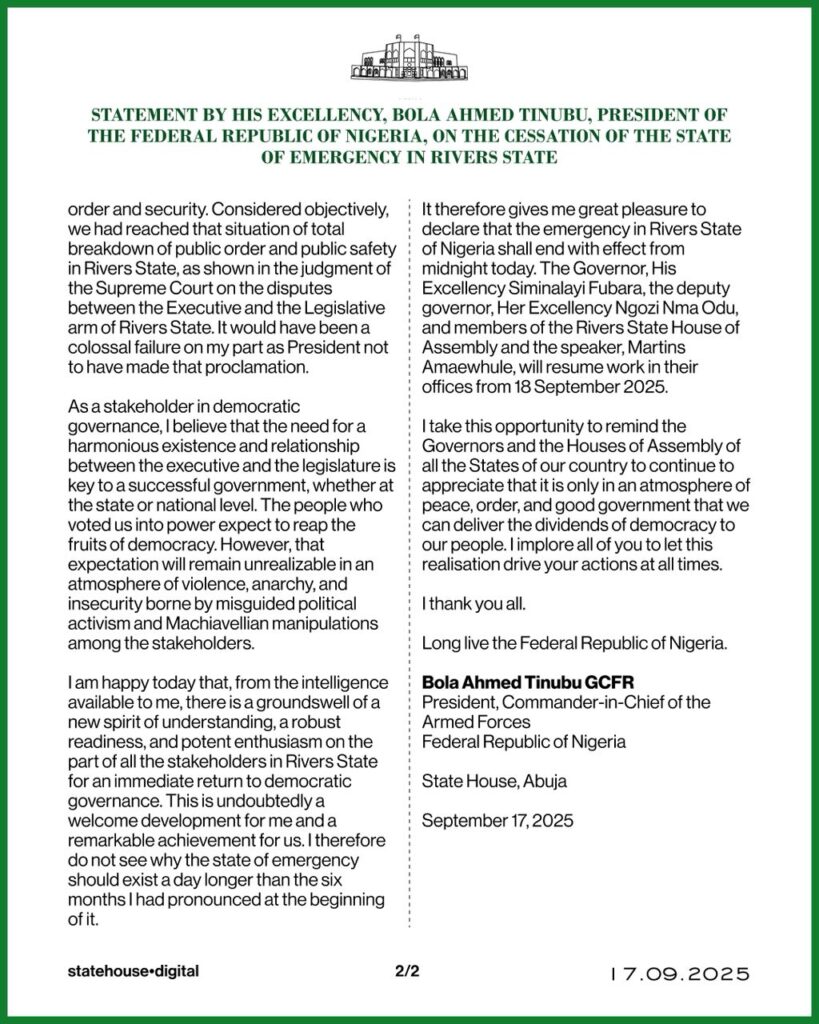
“It would have been a colossal failure on my part as President not to have made that proclamation,” Tinubu said. “But today, there is a groundswell of new understanding among Rivers stakeholders, and I see no reason for the emergency to last a day longer.”
He added that the move was necessary after the Supreme Court itself ruled there was “no government in Rivers State.”
The president praised the National Assembly for swiftly approving the proclamation in March, thanked traditional rulers and citizens of Rivers for their patience, and acknowledged critics who challenged the legality of the action in over 40 court cases.
With effect from midnight September 17, 2025, Tinubu said, democratic governance will return to Rivers State. He urged Governor Fubara, lawmakers, and political actors to “let peace, order, and good government drive their actions at all times.”
He urged political leaders nationwide to take lessons from Rivers: “It is only in an atmosphere of peace, order, and good government that we can deliver the dividends of democracy to our people.”
Tinubu’s move marks the first time since 2013 that Nigeria has placed a state under emergency rule and the first in the Fourth Republic where both the executive and legislature of a state were suspended simultaneously.
Under the emergency proclamation, the offices of the governor, deputy governor, and assembly members were suspended for six months while the federal government administered the state. The action sparked over 40 court cases across Abuja, Port Harcourt, and Yenagoa, with critics accusing the president of overreach.
Read the full statement: