

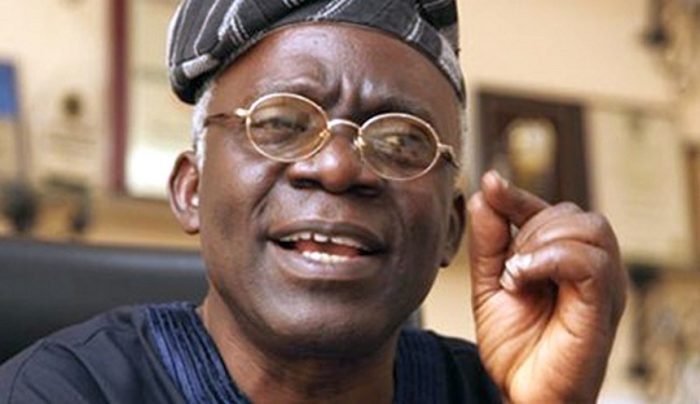
Femi Falana, human rights lawyer and senior advocate of Nigeria (SAN), says the World Bank and the International Monetary Fund (IMF) pushed the federal government to remove the petrol subsidies.
Falana, speaking on Channels Television’s ‘Sunday Politics’, stated that no government has totally eliminated subsidies.
“There’s no way you can remove subsidies completely; no country in the entire world has abolished subsidies completely,” he told me.
Countries such as the United States, the United Kingdom, France, and others provide subsidies for power, agriculture, and many other elements of people’s life.”
Falana stated that the withdrawal of petrol subsidies in Nigeria was not a domestic policy decision, but rather a demand enforced by international financial institutions.
“As a matter of fact, if I must say this, it was the World Bank and the International Monetary Fund (IMF) that insisted that the government must remove all subsidies,” he added.
President Bola Tinubu had announced the end of petrol subsidies on May 29, 2023, during his inauguration.
The CBN also announced the unification of all segments of the foreign exchange market.
The measures have resulted in record inflation, lowering the standard of living for many Nigerians.
Falana asked the administration to avoid increasing economic hardship when discussing the proposed five-percent fuel levy.
He said the government should first refund cash owed to the Federal Roads Maintenance Agency (FERMA), and that Nigerians should not be asked to pay new taxes.
According to the human rights lawyer, Section 14 of the FERMA Act 2007 created a 5% user tax on fuel purchases.
“The provision was clear: 40 percent for federal roads, 60 percent for state roads; sadly, the government never implemented it,” he said.
He also said that, between 2007 and 2011, FERMA confirmed that no funds were remitted despite deductions from petrol prices at source by regulators.
“We asked FERMA in 2011 how much was collected; they replied that the government never gave them a kobo,” Falana said.
He said that introducing a fresh surcharge could amount to multiple taxation, burdening already strained consumers.
“The money was deducted but not remitted; this new tax should first address those missing collections,” Falana added.
“By 2022, even the Senate confirmed that over one trillion naira was owed to FERMA.
“Before introducing new levies, the government must tell Nigerians what happened to the earlier deductions.”
Falana also advocated for an end to dollarisation, emphasising that rejecting the Nigerian naira is a criminal crime.